get quote
Leave Your Message

5 Best Hybrid Stepper Motor Suppliers for Global Buyers

Choosing a Hybrid Stepper Motor supplier involves more than comparing unit prices. Buyers need motors that match their load, motion profile, driver, and operating environment. A mismatch can cause missed steps, excess heat, or unwanted vibration. Small details matter.

This guide introduces five suppliers serving international buyers and outlines practical points for evaluating them. These include torque and speed data, step angle, rated current, shaft dimensions, wiring options, and available customization. Clear drawings and test information can help engineers check whether a motor fits an existing design before ordering samples. Ask about minimum order quantities, production lead times, packaging, and technical support, too. Shipping distance can affect schedules, while slow answers may complicate troubleshooting. A polished catalog can still leave important questions unanswered.

Supplier comparisons should be treated as a starting point, not a final verdict. Product ranges and service quality can change, and a strong fit for one application may not suit another. Verify specifications against the intended driver and mechanical load. Request current documentation, and confirm that stated certifications apply to the exact product and destination market. If possible, test samples under realistic conditions. It takes time. But skipping that step can be costly. The best choice is usually the supplier that communicates clearly, provides traceable product information, and can support your requirements consistently—not simply the one with the lowest quoted price.
5 Best Hybrid Stepper Motor Suppliers for Global Buyers

Hybrid Stepper Motors: Operating Principles and Common Applications

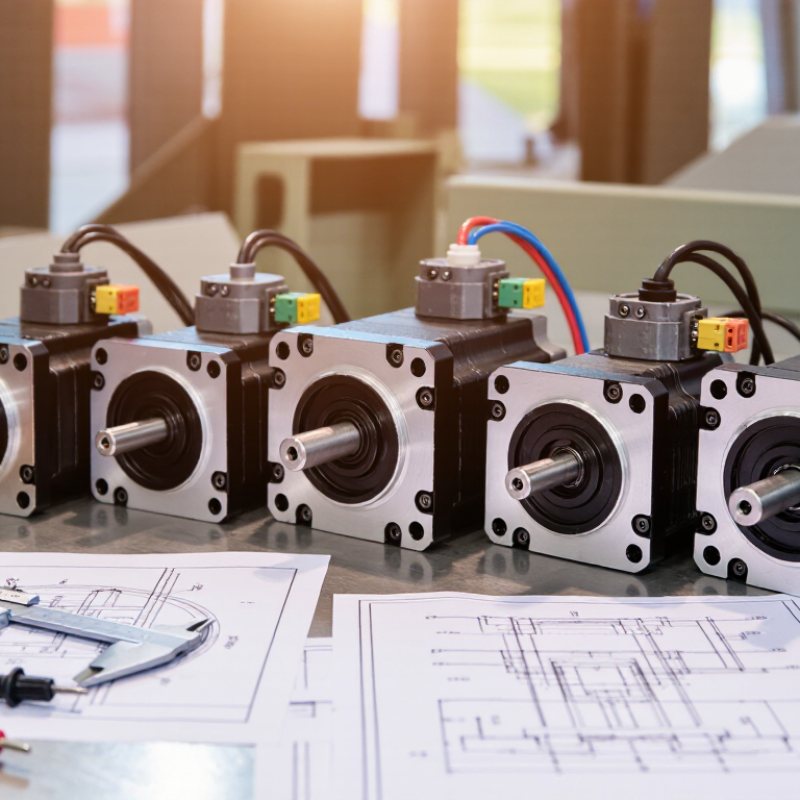
Hybrid stepper motors combine permanent-magnet rotors with toothed iron structures. Their stator coils energize in sequence, creating controlled magnetic steps. Each pulse moves the shaft by a defined angle.

Microstepping can make motion smoother. It also reduces vibration, but it does not always improve absolute accuracy. That point deserves attention. Open-loop control remains common because it lowers system cost. However, missed steps may occur under sudden loads, acceleration, or poor tuning. Heat is another practical concern. A motor running continuously at high current can become hot, even when the shaft barely moves.

According to a 2024 MarketsandMarkets report, the global stepper motor market is projected to grow from roughly USD 4.8 billion in 2023 to USD 6.5 billion by 2028. Demand comes from robotics, medical equipment, packaging, factory automation, and 3D printers. In a compact packaging machine, a hybrid stepper motor can index film rolls with repeatable positioning. In a laboratory pump, it can regulate small fluid volumes through controlled rotation. Industrial users should compare torque curves, duty cycles, noise, thermal limits, and driver compatibility. Rated holding torque alone can mislead buyers. Real performance depends on speed, load inertia, voltage, and acceleration settings.

5 Best Hybrid Stepper Motor Suppliers for Global Buyers - Hybrid Stepper Motors: Operating Principles and Common Applications

Supplier Profile Typical Product Range Operating Principle Typical Step Angle Typical Holding-Torque Range Common Applications Global-Buyer Selection Strength
Profile 1: Precision Motion Supplier NEMA 8–23 hybrid stepper motors; single-, dual-, and multi-stack designs A permanent-magnet rotor aligns with the sequentially energized teeth of a toothed stator, producing incremental shaft movement and usable holding torque at standstill. 1.8° standard; 0.9° high-resolution option 0.02–2.5 N·m, depending on frame size and stack length 3D printers, laboratory stages, inspection equipment, small CNC systems Suitable for buyers prioritizing positioning resolution, low vibration, and repeatable motion.
Profile 2: Industrial Automation Supplier NEMA 17–34 motors with encoder, brake, gearbox, and IP-rated options Two or more stator phases are energized by a controller in a defined sequence. The rotor follows the rotating magnetic field in discrete steps. 1.8° typical; microstepping can electronically subdivide each full step 0.4–8.0 N·m Conveyors, labeling machines, pick-and-place equipment, packaging lines A strong choice for integrators needing accessories, feedback options, and compatibility with industrial drivers.
Profile 3: High-Torque Motion Supplier NEMA 23–42 long-stack motors and two-phase high-torque configurations The hybrid rotor combines permanent-magnet torque with reluctance torque from its toothed structure, increasing alignment force and low-speed torque. 1.8° typical; custom step angles may be available 1.0–15.0 N·m CNC routers, robotic axes, textile machinery, high-load linear actuators Best suited to applications requiring high holding torque and controlled low-speed acceleration.
Profile 4: Compact OEM Supplier Miniature NEMA 6–17 motors with compact connectors and customized shafts The controller switches current through the motor windings to create a moving magnetic field; the rotor advances one magnetic step for each commanded sequence. 1.8° or 0.9° 0.01–0.8 N·m Medical pumps, camera mechanisms, office equipment, compact automation devices Useful for OEM projects where low mass, limited installation space, and customized mounting features matter.
Profile 5: Custom-Configuration Supplier Standard and customized two-phase or three-phase hybrid stepper motors The motor converts pulsed electrical input into angular displacement. Torque depends on phase current, magnetic design, step rate, rotor inertia, and load conditions. 0.72°, 0.9°, and 1.8° common options 0.05–12.0 N·m, subject to the customized design Solar tracking, automated valves, positioning platforms, specialized machinery Appropriate for global buyers needing customized voltage, winding, shaft, connector, thermal, or mounting specifications.
Buyer note: Actual torque, current, speed, temperature rise, and step accuracy vary by motor size, winding configuration, driver, supply voltage, load inertia, and operating conditions. Confirm the manufacturer’s datasheet and applicable compliance documentation before purchase.

How to Evaluate Hybrid Stepper Motor Suppliers

Choosing among the five best hybrid stepper motor suppliers requires more than comparing unit prices. Check their experience with your load, speed, and duty cycle. A supplier should explain torque curves, phase current, step angle, and allowable temperature rise clearly. Vague specifications deserve questions.

Request production samples before placing a large order. Measure holding torque, winding resistance, vibration, and noise at realistic driver settings. Test the motor after continuous operation, not only during a short bench check. Ask for inspection records, material traceability, and a documented quality process. Reliable suppliers can identify a batch from its label and production date.

Communication reveals technical maturity. Can the supplier recommend a motor after reviewing your acceleration profile? Do engineers answer directly, or send generic tables? Confirm shaft dimensions, mounting tolerances, connector options, packaging, and replacement procedures in writing. Ask how rejected units are handled. This detail matters.

I have learned that attractive torque numbers can mislead. A motor may perform well at low speed but lose force quickly at higher speeds. I once overlooked driver compatibility, and the prototype stalled during rapid movement. That mistake was avoidable. Compare test data under matching voltage and current conditions. Delivery promises also need evidence, such as recent lead-time records and realistic capacity statements. A dependable supplier admits limitations instead of promising everything. Suppliers who support sample testing, engineering review, and consistent documentation usually deserve closer evaluation.

Profiles of Five Global Suppliers: Oriental Motor, Nidec, MinebeaMitsumi, Nanotec, and MOONS’

Global buyers often compare hybrid stepper motor suppliers by torque charts alone. That approach is incomplete. Real performance depends on winding design, driver compatibility, thermal limits, documentation, and regional support.

Supplier One is known for compact motion products used in factory equipment and laboratory systems. Its strength is consistent engineering documentation and broad voltage options. Supplier Two serves demanding automation markets, where long service life and controlled production matter. Buyers should check connector standards carefully. Small differences can delay installation.

Supplier Three combines miniature motor expertise with high-volume manufacturing discipline. Its motors may suit compact devices with limited space and strict noise requirements. Supplier Four offers flexible motion solutions, including motors, gearboxes, and controllers. This can simplify system matching, especially for machine builders. Supplier Five has strong experience in integrated motion and industrial automation. Its product range can help global buyers source coordinated components from one channel.

I have found that published holding torque rarely tells the whole story. Test the motor at the intended speed. Measure heat after continuous operation. A cool prototype may become hot inside a sealed cabinet. That mistake is easy to make. Buyers should also request sample units, confirm certificates, review warranty terms, and assess local technical support. Delivery reliability matters as much as motor precision. One supplier may offer better pricing, while another provides clearer troubleshooting guidance. The best choice depends on the complete application, not a single specification.

This chart presents representative holding-torque levels commonly associated with five widely used hybrid stepper motor frame sizes. Actual performance varies by motor length, winding configuration, current rating, and operating conditions.

Comparing Product Range, Customization, Quality, and Technical Support

5 Best Hybrid Stepper Motor Suppliers for Global Buyers

Selecting among the five best hybrid stepper motor suppliers requires more than comparing catalog prices. Product range matters when projects need NEMA sizes, multiple torque ratings, integrated encoders, or planetary gearboxes. The International Federation of Robotics reported 541,302 industrial robot installations in 2023, showing continued demand for precise motion components. A supplier with broad, documented options can reduce redesign time.

Customization separates capable suppliers from simple resellers. Ask about winding changes, shaft geometry, connector placement, insulation class, and low-temperature performance. Technical teams should provide torque-speed curves, thermal limits, CAD files, and sample testing. One market analysis from MarketsandMarkets forecasts continued growth in the stepper motor sector through 2028, but growth alone does not prove engineering quality. Verify every claim.

Quality control needs measurable evidence. Look for incoming-material checks, rotor balancing, winding resistance tests, and end-of-line load testing. ISO 9001 certification supports process consistency, although it cannot replace independent sample inspection. Technical support should cover installation, resonance problems, driver matching, and failure analysis. Response speed matters. So does practical knowledge.

Global buyers should also examine traceability, packaging, lead times, and replacement policies. A supplier may offer impressive customization but struggle with repeat production. I have seen specifications that looked complete, yet omitted holding-torque tolerance. That omission can create costly surprises. Measure twice. Choose suppliers that share test records and admit operating limits, not those promising perfect performance.

Global Sourcing Factors: Certifications, Lead Times, and After-Sales Service

5 Best Hybrid Stepper Motor Suppliers for Global Buyers

Global buyers should verify certifications before comparing prices. ISO’s 2022 Survey recorded more than 1.26 million ISO 9001 certificates worldwide. Yet a certificate alone does not prove consistent motor performance. Ask for the current certificate, issuing body, scope, and factory address. For hybrid stepper motors, review electrical safety, electromagnetic compatibility, RoHS, and applicable IEC 60034 requirements. Request test reports for torque, insulation, temperature rise, and noise. Small details matter.

Lead time needs evidence, not optimistic emails. McKinsey reported that 93% of supply-chain leaders had invested in resilience after major disruptions. This finding still matters for motor sourcing. Ask suppliers to separate stock, production, testing, and shipping time. A practical check is a pilot order with fixed quantities and inspection points. Also confirm whether magnets, bearings, and drivers come from qualified sources. Delays often begin there. Three weeks may become eight.

After-sales service should be measurable. Require a response-time target, failure-analysis procedure, spare-parts policy, and technical contact who understands wiring and acceleration settings. Keep communication records. They protect both sides. World Bank’s 2023 Logistics Performance Index shows that customs, infrastructure, and logistics services strongly influence delivery reliability. Therefore, compare the supplier’s export experience, not only its factory location. I still treat impressive documents as clues, not proof. A perfect sourcing sheet is impossible. Trial data reveals more.