Choosing the right Linear Motor manufacturer can shape an entire motion system’s performance, cost, and service life. For global buyers, the decision involves more than advertised acceleration or attractive catalog prices. It requires careful comparison of engineering capability, production consistency, documentation, delivery reliability, and technical support.
This 2026 guide examines leading linear motor manufacturers serving international markets. It focuses on practical buying factors, including continuous force, peak force, stroke length, positioning accuracy, thermal management, encoder compatibility, and controller integration. Real applications often reveal the difference. A cleanroom stage may require low particle generation, while a packaging line may prioritize high duty cycles and quick maintenance. Details matter. Factory test reports, sample validation, and traceable quality procedures can provide stronger evidence than broad marketing claims.
The review also considers regional service coverage, spare-part availability, customization experience, and communication during installation. Buyers should verify certifications and import requirements for their destination country. A manufacturer with excellent products may still create delays if drawings, software, or after-sales support are difficult to obtain. Fit comes first.
No single ranking can satisfy every buyer. Application loads, environmental conditions, budget limits, and delivery schedules vary widely. Some manufacturers may offer impressive specifications but limited field support. Others may appear less prominent while providing dependable engineering assistance. That distinction deserves closer examination. By combining technical data with procurement experience and supplier verification, this overview aims to support more confident decisions in 2026. It also recognizes an uncomfortable truth: published performance does not always equal long-term system value. 马会
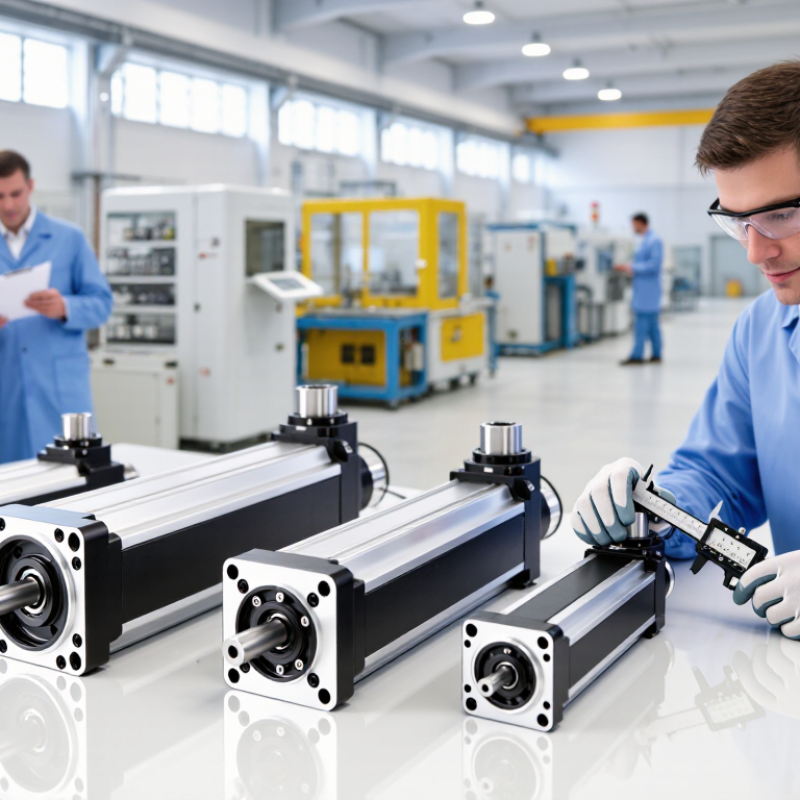
A linear motor creates motion without converting rotation through a screw, belt, or gearbox. Its moving force comes from electromagnetic interaction between a stationary section and a moving section. Think of it as an unrolled rotary motor. Magnets produce the field, while controlled current creates thrust along a straight path. The controller changes current direction and timing, so the carriage accelerates, stops, or reverses with precise feedback.
The working sequence is compact. A position sensor measures the carriage location, and the drive adjusts phase currents within milliseconds. The carriage then moves directly along a guide, often reaching high acceleration with little mechanical backlash. A 2024 linear motor market report from MarketsandMarkets forecasts growth at roughly 8% annually through 2028. The trend reflects demand for faster semiconductor, packaging, and inspection equipment. However, speed is not free. Copper losses create heat, and poor alignment can increase vibration and energy use.
The International Energy Agency reports that electric motor systems consume nearly half of global electricity. That makes efficiency more than a technical detail. In factory trials, engineers should check continuous force, peak force, cooling, cable movement, and guide stiffness. A motor may meet its catalog rating yet underperform in a dusty, warm machine. I have seen designs focus on acceleration while ignoring thermal settling. That was a costly assumption. Linear motors remove transmission wear, but they do not remove engineering risk.
Global buyers should evaluate linear motor manufacturers beyond catalog speed. According to the International Federation of Robotics’ World Robotics 2024 report, factories installed 541,302 industrial robots in 2023. This growth increases demand for precise, reliable motion systems. However, robot installation data does not prove linear motor quality. Buyers should verify force curves, continuous duty ratings, repeatability, thermal limits, and performance under real load conditions.
Testing evidence matters.
Ask for inspection records, life-test methods, calibration intervals, and failure-rate data. Compliance with ISO 9001 supports process consistency, while IEC 60068 testing can reveal resistance to vibration, shock, and temperature changes. For safety-related applications, manufacturers should explain their alignment with IEC 61800-5-2 or ISO 13849 requirements. Reports from MarketsandMarkets and Grand View Research indicate continued growth in precision motion markets, but market forecasts vary. Treat them as planning references, not guarantees.
Service capability can decide the purchase.
Check spare-part availability, encoder support, software compatibility, and response times across regions. Energy use also deserves attention; the International Energy Agency has reported that electric motors and related systems consume roughly 45% of global electricity. Efficient motion can reduce operating costs, especially in high-cycle equipment.
A clean spreadsheet can still mislead. I would request sample data from a pilot axis before approving a large order. Numbers matter. Real behavior matters more.
Top Linear Motor Manufacturers for Global Buyers in 2026
Global buyers are evaluating linear motor manufacturers beyond catalog specifications. They need stable force, accurate positioning, and reliable delivery across borders. In factory audits, engineers often inspect bearing alignment, encoder feedback, thermal behavior, and cable routing. Small details matter. A motor that reaches 0.1-micron repeatability in a laboratory may perform differently beside dust, vibration, and daily production heat.
Experienced manufacturers usually provide complete technical documentation, including force curves, duty-cycle limits, mounting drawings, and maintenance guidance. They should explain continuous force rather than advertising only peak force. That distinction affects sizing, cooling, and service life. Buyers should also request sample testing with their actual payload, stroke length, acceleration profile, and operating temperature. A polished demonstration can hide practical limitations.
International support is equally important in 2026. Clear export documents, responsive application engineers, spare-part planning, and regional service partners reduce costly downtime. Manufacturers with documented quality controls and traceable testing offer stronger reliability evidence. Certifications should match the destination market and machine category. Still, no supplier is flawless. One manufacturer may offer excellent motion accuracy but slow customization. Another may deliver quickly but provide limited failure analysis. Buyers should record these weaknesses instead of accepting optimistic sales language. A practical comparison table can include measured accuracy, lead time, warranty terms, integration support, and total ownership cost.
Anonymized technical and procurement comparison for global linear-motion buyers
| Supplier Profile | Primary Motor Type | Typical Continuous Force | Typical Peak Force | Typical Maximum Speed | Positioning Capability | Feedback Compatibility | Common Applications | Global Buyer Considerations | Typical Compliance Documents |
|---|---|---|---|---|---|---|---|---|---|
| Profile A | Iron-core linear motor | 200–2,000 N | 500–5,000 N | 1–5 m/s | Up to sub-micrometre with suitable scale and controller | Incremental or absolute linear encoder | Machine tools, semiconductor equipment, precision automation | High thrust density; thermal management and cogging control should be reviewed | ISO 9001, CE, RoHS, EMC documentation |
| Profile B | Ironless linear motor | 50–800 N | 150–2,000 N | 2–10 m/s | Very low velocity ripple with optimized control | Optical, magnetic, or inductive linear scale | Inspection systems, laboratory automation, electronics assembly | Low moving mass and zero cogging; lower force density than iron-core designs | ISO 9001, CE, RoHS, REACH declarations |
| Profile C | Tubular linear motor | 20–500 N | 50–1,200 N | 0.5–3 m/s | Micrometre-level with closed-loop feedback | Hall sensors, encoder, or resolver-based feedback | Pick-and-place equipment, packaging, medical mechanisms | Compact cylindrical form factor; confirm stroke, sealing, and cooling requirements | ISO 9001, CE, RoHS, product safety test reports |
| Profile D | U-channel linear motor | 100–1,500 N | 250–3,500 N | 1–6 m/s | Sub-micrometre capability in precision configurations | Linear encoder and Hall-effect commutation sensors | Multi-axis stages, digital manufacturing, vision-guided automation | Good balance of stiffness and compactness; verify magnetic-force interaction | ISO 9001, CE, RoHS, EMC and risk-assessment files |
| Profile E | Flat linear motor | 30–600 N | 100–1,500 N | 1–8 m/s | Micrometre-level; higher accuracy depends on scale and mechanics | Incremental encoder or absolute linear encoder | Conveyance, sorting, dispensing, and general factory automation | Flexible installation and competitive system cost; evaluate heat dissipation | ISO 9001, CE, RoHS, installation and wiring instructions |
| Profile F | Long-stroke linear motor system | 100–1,000 N | 250–2,500 N | 2–5 m/s | Micrometre-level over extended travel when properly calibrated | Linear scale with servo drive feedback loop | Large-format inspection, logistics automation, gantry systems | Confirm thermal expansion, cable management, alignment, and long-travel accuracy | ISO 9001, CE, RoHS, environmental and EMC test records |
| Profile G | High-acceleration linear actuator | 50–700 N | 150–1,800 N | 3–12 m/s | Fast settling with controller-dependent repeatability | High-resolution encoder and servo drive | Rapid packaging, electronic component placement, high-cycle automation | Prioritize acceleration, duty cycle, vibration, and regenerative braking analysis | ISO 9001, CE, RoHS, machinery risk documentation |
| Profile H | Cleanroom linear motor module | 50–900 N | 150–2,200 N | 0.5–4 m/s | Sub-micrometre capability in controlled environments | Vacuum-compatible or cleanroom-rated linear encoder | Wafer handling, optical inspection, pharmaceutical automation | Check particle-generation data, outgassing, lubricants, and cleanroom classification | ISO 9001, CE, RoHS, cleanroom test data, material declarations |
Choosing the best linear motor manufacturer in 2026 requires comparing motor types, not just catalog speed. Iron-core motors deliver high thrust density for machine tools and semiconductor stages. Ironless designs reduce cogging and improve motion smoothness. Tubular motors suit compact pick-and-place systems, while voice-coil motors provide short, precise travel. According to MarketsandMarkets’ 2024 report, the linear motor market could grow from about USD 1.3 billion in 2024 to USD 2.0 billion by 2029, representing a 9.5% compound annual growth rate.
Performance depends on the complete motion system. Check continuous force, peak force, acceleration, force ripple, thermal limits, encoder resolution, and duty cycle. A motor rated for 10 g acceleration may require aggressive cooling and a lightweight payload. Grand View Research identified industrial automation as a major demand area in its 2024 market analysis, driven by faster production and tighter positioning requirements. In real factory evaluations, cable management and contamination often matter as much as headline speed. This is easy to underestimate.
Tips: Ask for measured force curves, thermal test conditions, and repeatability data. Compare identical payloads and travel lengths. Do not trust speed alone. A 0.1-millimeter positioning claim may change under heat, vibration, or poor alignment. Engineers should also review maintenance access and controller compatibility before approving a global supplier. Need is application-specific.
Selecting the right linear motor supplier requires more than comparing catalog prices. The International Federation of Robotics reported 541,302 industrial robots installed worldwide in 2023, a 10% annual increase. This growth raises demand for faster, cleaner, and more precise motion systems.
Start with application data. Define payload, stroke length, acceleration, duty cycle, positioning tolerance, and ambient temperature. Ask suppliers for measured force curves, thermal test results, and repeatability data. A serious supplier should explain coil heating, encoder resolution, maintenance needs, and expected service life. Request samples or a factory acceptance test before approving volume production.
Check engineering depth and supply reliability. Review quality certifications, component traceability, spare-part availability, and technical support across time zones. The supplier should provide drawings, simulation support, and clear integration limits. Do not trust impressive speed figures alone. They may depend on short strokes and light loads.
A lower price can become expensive later. In one line-design review, insufficient cooling caused unstable positioning after continuous operation. That mistake changed the supplier evaluation process. No shortlist is perfect. Recheck assumptions with real production conditions, not only laboratory specifications. Geological location, export procedures, communication quality, and warranty response also matter when buying internationally.