2026 Top Stepper Drive Manufacturers for Global Buyers
Choosing a Stepper Drive manufacturer in 2026 requires more than comparing catalog prices. Global buyers need stable motion, documented quality, responsive engineering, and realistic delivery commitments. A drive may look impressive online, yet fail under heat, vibration, or repeated acceleration. This guide examines leading manufacturers through practical buyer concerns, including motor compatibility, current control, microstepping, protection features, certifications, and after-sales support. It also considers factory capabilities, application records, and available technical documentation. Numbers matter. So does consistency.
Experienced engineers often test a drive with the intended motor, not a generic laboratory unit. They check audible resonance at low speed, cabinet temperature after several hours, alarm behavior, and connector quality. A packaging machine, CNC axis, and medical positioning system may require very different responses. For international purchasing teams, voltage ranges, communication protocols, firmware access, spare-part supply, and regional service can influence total cost. A low purchase price may become expensive when commissioning support remains unclear. That risk deserves attention.
The manufacturers discussed here are assessed for engineering depth, production reliability, product range, and buyer support. Public claims alone are insufficient, and some company data remains difficult to compare fairly. No ranking is perfect. Buyers should verify test reports, warranty terms, lead times, and compliance documents before placing orders. This overview offers a practical starting point, not a substitute for application testing. A careful shortlist can reduce downtime and improve confidence across global projects. Mistakes still happen. Careful review limits them.
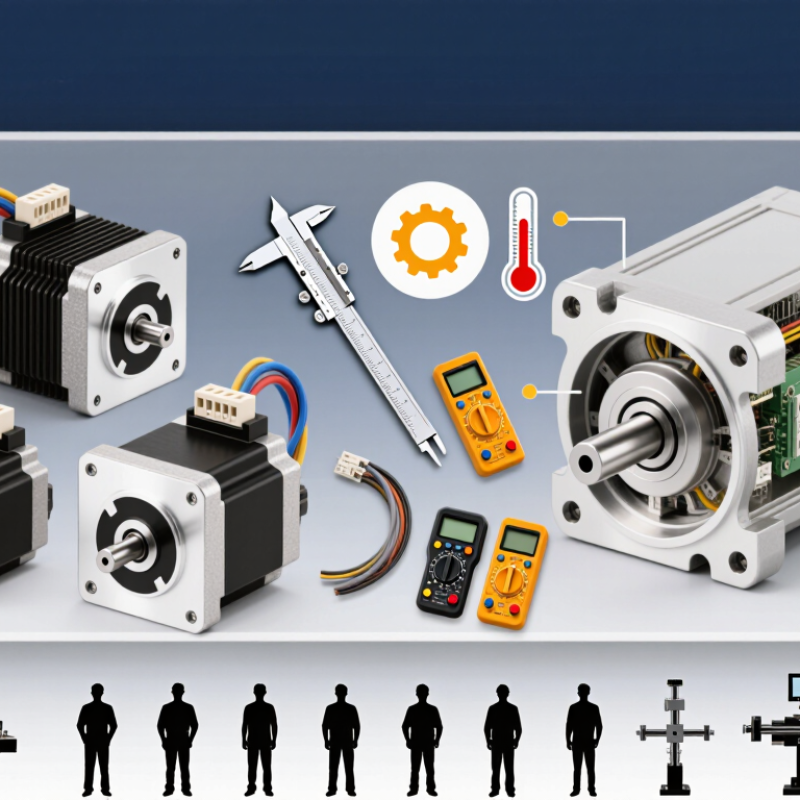
Define the 2026 Market: NEMA 8–42 Frames and 1.8° Step Angles
2026 Top Stepper Drive Manufacturers for Global Buyers
Define the 2026 Market: NEMA 8–42 Frames and 1.8° Step Angles
The 2026 stepper drive market covers compact NEMA 8 motors through larger NEMA 42 assemblies. Frame size describes mounting dimensions, not complete motor capability. Buyers should check shaft length, pilot diameter, connector placement, and available torque curves. A small NEMA 8 may suit laboratory positioning, while a NEMA 34 or 42 often supports heavier machinery. Real machines are less tidy than catalog tables.
A 1.8° step angle gives 200 full steps per revolution. This remains a practical reference for indexing, packaging, inspection, and light automation. Microstepping can improve motion smoothness, but it does not automatically increase positioning accuracy. Load inertia, acceleration, resonance, and mechanical backlash still matter. Test the motor with the actual coupling and payload.
Reliable manufacturers provide measured current ratings, thermal limits, wiring diagrams, and repeatable production records. Global buyers should request samples, inspection reports, firmware details, and region-specific conformity documents. Confirm whether the drive supports the motor’s phase current and supply voltage. Pay attention to heat near the connector. That small detail can expose a weak design. Price alone is a poor filter, yet premium specifications can also hide unnecessary complexity. A careful supplier comparison should include lifecycle support, replacement availability, and response quality after the first shipment.
2026 Global Buyer Reference
2026 Top Stepper Drive Manufacturers for Global Buyers - Define the 2026 Market: NEMA 8–42 Frames and 1.8° Step Angles
Technical market map for standard 1.8° hybrid stepper motor formats and compatible drive selection.
| NEMA frame |
Face size
approx. mm |
Standard step angle |
Full steps per revolution |
Typical holding-torque range |
Typical phase-current range |
Common drive supply class |
Typical 2026 applications |
| NEMA 8 |
20 × 20 |
1.8° |
200 |
0.01–0.05 N·m |
0.3–0.8 A/phase |
12–24 VDC |
Compact optics, miniature stages, laboratory mechanisms |
| NEMA 11 |
28 × 28 |
1.8° |
200 |
0.02–0.10 N·m |
0.4–1.0 A/phase |
12–24 VDC |
Small medical devices, valve actuation, compact automation |
| NEMA 14 |
35 × 35 |
1.8° |
200 |
0.05–0.25 N·m |
0.6–1.5 A/phase |
12–36 VDC |
Desktop equipment, compact conveyors, instrumentation |
| NEMA 17 |
42 × 42 |
1.8° |
200 |
0.15–0.70 N·m |
0.8–2.0 A/phase |
12–48 VDC |
3D printers, small CNC equipment, laboratory and packaging systems |
| NEMA 23 |
58.4 × 58.4 |
1.8° |
200 |
0.50–2.20 N·m |
1.5–4.2 A/phase |
24–48 VDC |
CNC routers, pick-and-place equipment, indexing tables and general automation |
| NEMA 24 |
61 × 61 |
1.8° |
200 |
1.00–3.00 N·m |
2.0–5.0 A/phase |
24–60 VDC |
Medium-duty motion control, feeders, conveyors and retrofit machinery |
| NEMA 34 |
86 × 86 |
1.8° |
200 |
2.00–8.00 N·m |
3.0–7.0 A/phase |
36–80 VDC |
Heavy CNC axes, industrial positioning, robotics and large-format equipment |
| NEMA 42 |
107 × 107 |
1.8° |
200 |
5.00–20.00 N·m |
4.0–10.0 A/phase |
48–120 VDC or 110–230 VAC drive systems |
High-load gantries, machine tools, industrial handling and large automation platforms |
Buyer qualification note:
NEMA frame numbers primarily identify the motor mounting-face size and do not guarantee shaft length, winding resistance, torque, current, connector style or mounting-hole pattern. The torque and current values shown are indicative market ranges for common 1.8° two-phase hybrid stepper motors; final selection must be verified against the individual motor and drive datasheets.
Recommended drive-selection checkpoints
Rated phase current
DC-bus voltage
Microstep resolution
Peak speed and load inertia
Feedback or closed-loop requirement
Thermal and compliance requirements
Evaluate Manufacturers by IEC 61800-5-2, CE, UL, and RoHS Compliance
2026 Top Stepper Drive Manufacturers for Global Buyers
When evaluating stepper drive manufacturers, compliance should be checked beyond a certificate displayed online. IEC 61800-5-2 is especially important where functional safety affects machinery behavior. Ask whether the assessment covers the exact drive series, firmware, and safety functions being purchased.
CE marking requires attention to the applicable European directives, technical file, risk assessment, and declaration of conformity. The document should identify the precise model and revision. UL recognition or listing can support acceptance in North American installations, but its scope matters. Check voltage ranges, enclosure conditions, wiring methods, and approved accessories. A familiar logo is not enough.
RoHS evidence should include material declarations and supply-chain controls, not only a brief statement. During practical reviews, inspect labels, manuals, terminal markings, and traceability records. Test samples under realistic cabinet temperatures, cable lengths, and load changes. Watch for overheating. Also compare fault handling and documentation quality. IEC 61800-5-2 compliance may not cover every machine-level safety requirement, so system integration still needs engineering review.
I have seen evaluations rely too heavily on certificates and overlook firmware changes or regional variants. That is a weakness worth acknowledging. Reliable manufacturers provide current reports, responsive technical answers, and consistent production records. Small details often reveal the difference.
Rank Global Suppliers by Torque, Warranty, Lead Times, and Regional Support
2026 Top Stepper Drive Manufacturers for Global Buyers
A credible 2026 ranking should measure more than catalog torque. MarketsandMarkets projects the global stepper motor market to grow from about USD 4.8 billion in 2023 to USD 6.7 billion by 2028, at a 6.9% CAGR. That expansion raises sourcing pressure. Buyers should compare continuous torque, peak torque, thermal protection, and microstepping stability under real loads. A 2.0 N·m rating means little without duty-cycle data.
Warranty length is useful, but failure handling matters more. Score suppliers by warranty coverage, repair procedures, spare-drive availability, and documented failure analysis. A two-year warranty with slow communication can underperform a shorter warranty with regional technicians. It happens.
Lead time also needs evidence. Request stock status, production capacity, minimum order quantities, and emergency replenishment terms. Do not trust “fast delivery” without a written schedule.
Regional support should carry serious weight in the ranking. The World Bank’s Logistics Performance Index 2023 shows wide differences in customs reliability, shipment tracking, and delivery predictability across markets. Therefore, suppliers with local inventory, multilingual engineers, and certified service partners deserve higher scores.
| A practical model could assign 30% to torque and thermal performance |
20% to warranty |
25% to lead time |
25% to regional support. |
This weighting is not universal. Packaging machinery, laboratory equipment, and robotics require different priorities. Test reports and customer references should decide the final position.





 Daniel.Ding
 Ding
Ding