What Are the 2026 Top Types of Stepper Motors?
Choosing the right Stepper Motor in 2026 requires more than comparing holding torque or price. Modern machines demand quieter motion, better efficiency, compact designs, and dependable positioning under changing loads. A motor that performs well on a workbench may behave differently inside a warm, enclosed cabinet.
This guide examines the leading stepper motor types used in automation, robotics, 3D printers, medical equipment, and precision instruments. It considers hybrid, permanent magnet, variable reluctance, geared, and linear configurations. Each design creates motion differently. Each also brings practical compromises. Hybrid motors usually provide strong torque and fine resolution, while permanent magnet models can offer simpler construction. Variable reluctance motors may reduce rotor inertia, but their control requirements deserve careful attention.
Real-world selection depends on more than specifications. Engineers should review rated current, winding resistance, step angle, speed range, driver compatibility, vibration, and heat buildup. Datasheets provide essential evidence, yet measured performance remains valuable. A motor may reach its listed torque only at low speed. That detail is easy to miss.
Small details matter.
The article also considers emerging expectations for 2026, including closed-loop control, integrated drives, quieter operation, and energy-aware designs. Some market claims remain difficult to compare because manufacturers use different testing conditions. That uncertainty deserves honesty. By connecting technical principles with practical examples, this overview helps readers judge which Stepper Motor type fits their application, budget, and reliability targets.
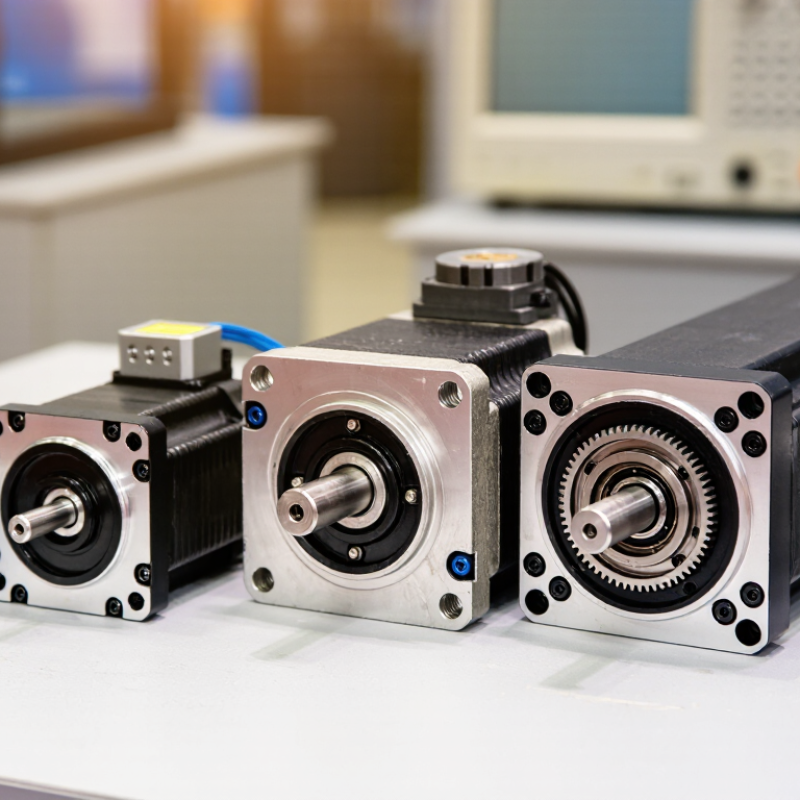
What Defines a Stepper Motor in 2026?
A stepper motor is defined by controlled, incremental rotation. Its rotor moves through measured angular positions when the controller energizes stator windings in sequence. Unlike a typical brushed motor, it uses electronic switching and has no mechanical commutator. The most common designs in 2026 are permanent-magnet, variable-reluctance, and hybrid steppers. Hybrid motors combine magnetic attraction with permanent-magnet torque. They usually provide finer steps and stronger holding force.
Microstepping makes movement smoother. It divides a full step into smaller electrical commands, reducing vibration and audible noise. However, microstepping does not guarantee equal mechanical accuracy. Load, friction, resonance, and supply voltage still matter. This is where specifications can mislead. A motor may claim very fine resolution while its real shaft position shifts under heavy acceleration.
In equipment testing, I examine motion at startup, low speed, and sudden load changes. A two-phase stepper suits many compact positioning systems. A three-phase design can reduce torque ripple in demanding applications. Closed-loop steppers add an encoder and correct lost-position errors, although they increase wiring and system cost. Integrated motors simplify installation but may limit service options. Thermal behavior deserves attention: a motor holding position for hours can become surprisingly hot. The ideal type depends on torque, speed, duty cycle, noise, and the consequences of missed steps. Perfect motion rarely exists.
How Permanent-Magnet, Variable-Reluctance, and Hybrid Motors Differ
What Are the 2026 Top Types of Stepper Motors?
Permanent-magnet, variable-reluctance, and hybrid motors remain important choices in 2026. Their differences begin with rotor construction. Permanent-magnet motors use a magnetized rotor, producing steady torque at low speed. They are compact and affordable, but their resolution and holding strength can be limited. Variable-reluctance motors use a toothed iron rotor without permanent magnets. They respond quickly and tolerate high temperatures, yet they usually deliver weaker holding torque.
Hybrid motors combine permanent magnets with toothed rotor structures. This design provides finer positioning, stronger torque, and smoother operation. It is common in precision machinery, laboratory instruments, and automated production equipment. However, hybrid motors can cost more and may require careful current control. A larger motor is not automatically better. Bench testing often exposes vibration, missed steps, or excessive heat that specifications fail to show.
Tips: Match the motor to load torque, speed, resolution, and duty cycle. Check acceleration requirements, not only holding torque. Use a suitable driver and verify temperature during continuous operation. A simple test with the real mechanism is valuable. The “best” type can change after friction, wiring, or mounting errors appear. That part is easy to underestimate.
Which Stepper Motor Types Fit Different Applications?
Stepper motor selection depends on the application, not on a popular specification alone. Hybrid stepper motors suit CNC axes, 3D printers, and compact automation equipment. Their toothed rotor and stator create strong holding torque and accurate incremental movement. They also perform well at low and medium speeds. However, resonance can cause vibration if acceleration and current settings are poorly matched.
Permanent magnet stepper motors fit simpler mechanisms, such as valve controls, small gauges, and lightweight positioning units. They usually offer lower torque but require simpler control. Variable reluctance motors can respond quickly and keep the rotor design relatively light. They may suit laboratory instruments or fast indexing systems where holding torque is less important. The choice is not always clean.
Closed-loop stepper systems add feedback through an encoder. They can reduce missed-step risk in conveyors, robotic slides, and camera positioning equipment. This option helps when loads change suddenly or stopping accuracy matters. Still, feedback does not correct every mechanical weakness. Backlash, flexible couplings, and poor alignment remain serious problems.
For dusty factory equipment, designers should check sealing, heat rise, and cable protection. For battery-powered devices, winding resistance and driver efficiency deserve closer attention. I have seen projects focus on peak torque, then ignore speed torque curves. That mistake can produce stalls during real movement. Testing the motor with the actual load, acceleration, duty cycle, and mounting structure is more reliable than selecting from a catalog table alone.
What Are the 2026 Top Types of Stepper Motors?
Which stepper motor types fit different applications?
Permanent-Magnet Stepper
Commonly uses a larger step angle and offers simple, economical positioning. It fits low-speed instruments, small actuators, valve control, and compact consumer mechanisms.
Variable-Reluctance Stepper
Its toothed iron rotor provides fast response and low rotor inertia. It is suitable for lightweight positioning systems, indexing devices, and applications where moderate resolution is sufficient.
Hybrid Stepper
Combining permanent-magnet and variable-reluctance principles, it typically provides 1.8° or 0.9° steps, higher positioning resolution, and strong holding torque for CNC equipment, 3D printers, robotics, and automation.
The chart shows representative full-step angles commonly used in stepper motor designs. Actual specifications vary with motor size, winding configuration, drive mode, and manufacturer.
How to Choose the Right Stepper Motor for 2026 Projects
Choosing the right stepper motor for 2026 projects starts with motion requirements, not catalog popularity. Hybrid stepper motors remain strong for CNC axes, 3D printers, and compact automation. Their toothed rotor delivers higher holding torque and finer positioning than permanent-magnet designs. Variable-reluctance motors suit lightweight mechanisms, but their lower torque can limit vertical loads. Permanent-magnet motors remain practical for simple, cost-sensitive movements.
Industry data supports this demand. The International Federation of Robotics reported 541,302 industrial robot installations in 2023, a 2% annual increase. More robotic joints and feeders require predictable low-speed motion. MarketsandMarkets’ 2024 stepper motor analysis also projects mid-single-digit market growth through 2029. That growth does not mean every project needs a stronger motor.
Match torque carefully. A motor lifting a 3-kilogram slide needs more than its static load suggests. Acceleration, friction, screw pitch, and safety margin change the calculation. For high-speed movement, check torque-speed curves instead of relying on holding torque.
Closed-loop stepper systems can detect position loss and reduce wasted energy, but they add sensors, tuning, and cost.
Often overlooked.
For dusty equipment, select suitable sealing and thermal ratings. For quiet laboratory equipment, microstepping can reduce vibration, although it does not always improve absolute accuracy. Test the motor with the real driver, supply voltage, load, and duty cycle.
Measure twice. A smaller motor may run cooler and faster, while an oversized motor can create resonance, heat, and unnecessary expense.




 Daniel.Ding
 Ding