Why Choose Linear Motors for Your Industrial Applications?
Linear motors have gained attention in industrial applications due to their unique benefits. Unlike traditional rotary motors, linear motors provide direct linear motion. This results in improved efficiency and precision in various tasks. Industries are increasingly seeking automation solutions that enhance productivity.
Understanding the advantages of linear motors is crucial for businesses. These motors offer faster response times and less maintenance compared to their counterparts. Technological advancements make them more accessible than ever. However, some companies hesitate to switch due to high initial costs.
Embracing linear motors could lead to significant long-term gains. The transition may involve challenges and require staff training. A careful evaluation is necessary to fully grasp their potential. Linear motors are not without flaws, but their advantages often outweigh the shortcomings when implemented thoughtfully.
Overview of Linear Motors in Industrial Applications
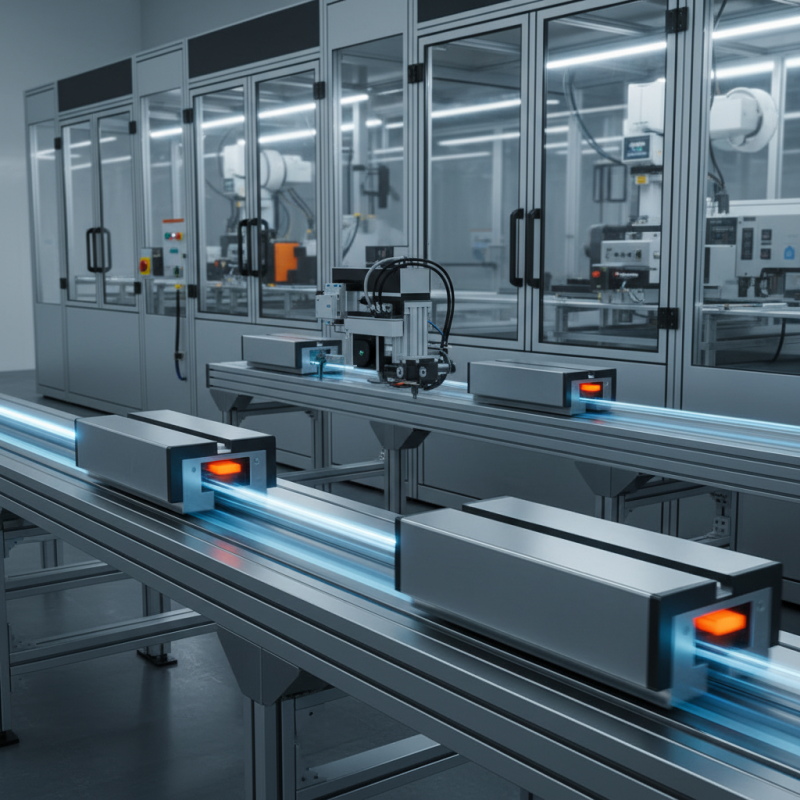
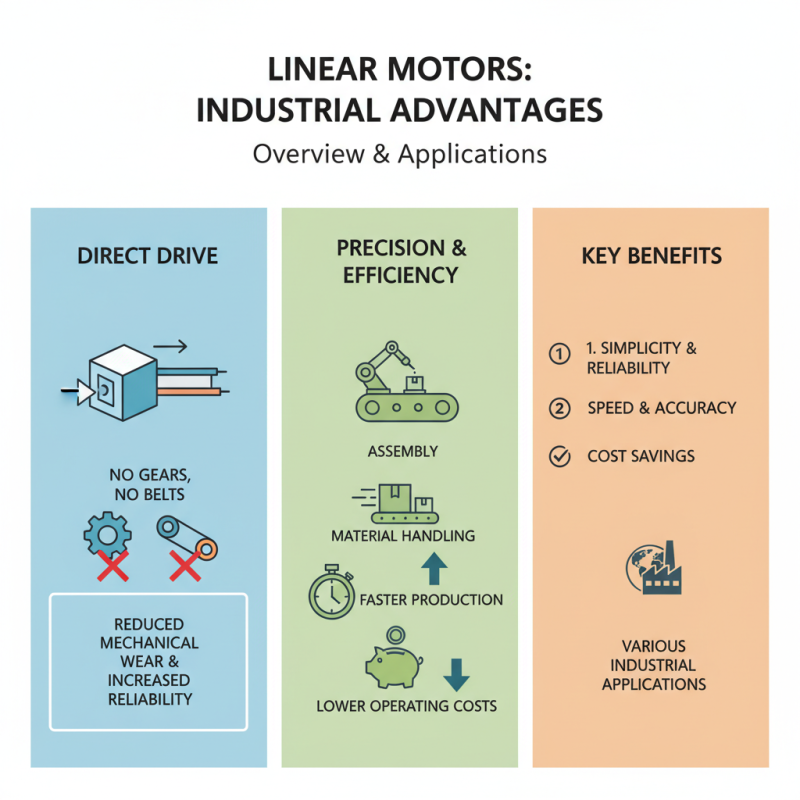
Linear motors have become increasingly popular in various industrial applications. They provide a direct drive solution that eliminates the need for gears and belts. This reduces mechanical wear and increases reliability. Industries use them for precision tasks such as assembly and material handling. The efficiency of linear motors can lead to faster production times and lower operating costs.
One notable feature is their ability to deliver high acceleration. This is especially useful in automation processes. However, the initial costs can be higher compared to traditional systems. Maintenance is relatively low, but both training and familiarity with technology can pose challenges for some teams. The integration of linear motors into existing systems may also require redesigns, which can be time-consuming.
Despite these challenges, linear motors offer significant benefits. They operate with minimal noise and have a compact design. Space-saving solutions can be critical in crowded factories. The precision and speed they offer are hard to match. As industries continue to innovate, the role of linear motors in enhancing productivity will likely grow. Careful evaluation will ensure their proper implementation and maximize their advantages.
Advantages of Linear Motors Over Traditional Drive Systems
Linear motors are gaining popularity in industrial applications. Their advantages over traditional drive systems are significant. For instance, linear motors provide direct drive, eliminating the need for gears or belts. This results in high efficiency and reduced maintenance costs. According to industry reports, linear motors can boost productivity by up to 30%.
Precision is another major benefit. These motors offer accurate positioning within 0.01 mm. This level of precision is crucial in fields like semiconductor fabrication and material handling. Traditional drive systems often fall short in these demanding applications. Some manufacturers report a 40% increase in quality consistency when switching to linear motors.
Tips: When considering a switch, assess your production requirements. Identify areas where efficiency can improve. While linear motors offer many advantages, remember that integration can be challenging. Evaluate your existing systems carefully. Researching and planning can help ensure a smoother transition.
Understanding the cost implications is also essential. Initial investments in linear motors may be higher. However, the long-term savings on operation and maintenance can be substantial. Many companies find that they recoup their investments within 18 months due to increased uptime and productivity.
Key Factors to Consider When Selecting Linear Motors
When selecting linear motors for industrial applications, it is crucial to consider several key factors. The accuracy of positioning is one of them. High precision is necessary for tasks like assembly, where every millimeter counts. Motors with minimal backlash are often preferred. This prevents errors in fast-paced environments. Without this precision, the entire production line could suffer.
Another factor is the speed and acceleration capabilities. Different jobs require different motor performance. A good linear motor can achieve rapid movements while maintaining control. However, not all applications need high speed. Sometimes, slower motors suffice for heavy loads. It's often about finding a balance.
Efficiency is also an essential consideration. Efficient motors save energy and reduce operating costs. But, higher efficiency can lead to increased initial costs. This trade-off must be analyzed carefully. It's essential to look beyond just price. The impact on long-term savings should guide the decision. It’s not always an easy choice, and it can lead to reflection on priorities in your operations.
Why Choose Linear Motors for Your Industrial Applications? - Key Factors to Consider When Selecting Linear Motors
| Factor |
Description |
Importance |
Typical Applications |
| Accuracy |
Linear motors provide high precision positioning, crucial for tasks requiring exact movements. |
High |
Robotic arms, CNC machines |
| Speed |
They offer rapid acceleration and high speeds, enhancing productivity in manufacturing processes. |
Medium |
Packaging machines, conveyors |
| Maintenance |
Linear motors have fewer moving parts, resulting in lower maintenance needs. |
High |
Automated guided vehicles (AGVs) |
| Size and Design Flexibility |
Available in various sizes, easily integrating into existing systems while meeting space constraints. |
Medium |
Custom machinery, automated assembly lines |
| Energy Efficiency |
Linear motors typically offer increased energy efficiency, leading to lower operational costs. |
High |
Sustainable manufacturing processes |
Common Applications of Linear Motors in Various Industries
Linear motors are becoming increasingly popular in various industries due to their unique advantages. They are often used in applications such as aerospace, automotive manufacturing, and assembly lines. In aerospace, linear motors can provide precise control and high speed, essential for components like automated landing gear systems. The automotive industry utilizes them in robotic arms for assembly, where speed and accuracy reduce production times significantly.
In packaging, linear motors allow for high-speed sorting and precise placements. According to recent industry reports, the global linear motor market is expected to grow at a CAGR of over 12% from 2023 to 2030. This growth highlights their versatility across sectors.
Tip: Consider the specific requirements of your application before selecting a linear motor. It’s crucial to analyze load specifications and required speed.
Moreover, in semiconductor manufacturing, linear motors play a pivotal role. They improve efficiency during wafer handling processes, as minimal inertia ensures swift movement. However, the high initial costs of linear motors might deter some companies. Companies must weigh the upfront investment against long-term savings in productivity and efficiency.
Tip: Conduct a cost-benefit analysis. Understanding your ROI can help in making an informed decision.
Common Applications of Linear Motors in Various Industries
Future Trends and Innovations in Linear Motor Technology
Linear motors are transforming various industrial applications, driven by future trends and innovations. According to a recent industry report, the global linear motor market is projected to grow at a CAGR of 8.5% from 2022 to 2028. This growth reflects the increasing demand for precision and energy efficiency in manufacturing. Industries are adopting these motors for their capability to deliver high-speed operations and reduced maintenance needs.
Innovations in linear motor technology include enhanced control algorithms and improved cooling systems. These advancements enable better performance in extreme conditions. Research indicates that companies implementing linear motors can reduce energy consumption by up to 30%. Despite these benefits, some manufacturers express concerns about the initial investment costs, which may deter adoption. Striking a balance between upfront costs and long-term efficiency remains a challenge.
In addition, the integration of artificial intelligence with linear motors is an emerging trend. This integration allows for predictive maintenance, optimizing runtime and minimizing downtime. However, not all companies possess the necessary infrastructure to leverage these innovations fully. As the technology advances, addressing these gaps will be crucial for widespread adoption.



 Daniel.Ding
 Ding
Ding